

Regular cardio does much more than burn calories.
When you consistently perform aerobic exercise at an appropriate intensity, your muscles can actually develop a greater network of tiny blood vessels called capillaries.
That means a better-developed blood supply around the muscles doing the work.
This improved network helps deliver oxygen and circulating energy sources to working muscle. It also supports the transport of metabolic products away from the tissue.
In other words, cardio can help improve the entire system responsible for delivering and using energy.
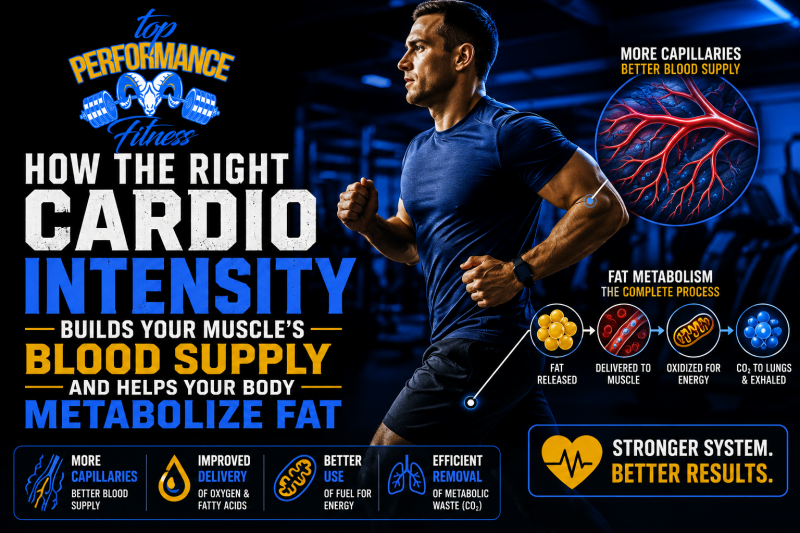
What Are Capillaries?
Capillaries are the smallest blood vessels in the body.
They are where much of the exchange between your blood and your tissues takes place.
Oxygen and energy substrates move toward working muscles, while metabolic products move from the tissues back into circulation.
A useful way to think about it is this:
Your larger blood vessels are like highways.
Capillaries are the smaller roads that actually reach your muscle fibers.
The more developed this network becomes, the better equipped your muscles are for aerobic work.
Can Cardio Really Grow More Capillaries?
Yes.
This is a well-established adaptation to aerobic exercise.
The development of new blood vessels from an existing vascular network is called angiogenesis.
Researchers have examined human skeletal muscle before and after training and have measured increases in the capillary network surrounding muscle fibers.
A large 2025 systematic review examined approximately 50 years of exercise research.
The researchers found increases in capillaries per muscle fiber of about 15% following endurance training, 13% following high-intensity training, and 10% following sprint-interval training.
Traditional endurance training also produced about a 13% increase in capillary density (Mølmen et al., 2025).
These changes have been measured in human skeletal muscle.
Why Does Your Body Build More Capillaries?
Your body adapts to the demands you repeatedly place on it.
During aerobic exercise, your working muscles need more oxygen and energy.
Blood flow to those muscles increases to meet that demand.
Repeated muscle contractions and increased blood flow create signals that encourage the vascular system to adapt.
One of those signals is called shear stress. This is the force created as increased blood flow moves along the inside of blood vessels.
Exercise also affects substances involved in blood-vessel growth, including vascular endothelial growth factor, better known as VEGF.
VEGF plays an important role in stimulating new capillary development (Hoier & Hellsten, 2014).
Simply put, when you repeatedly ask your muscles to perform aerobic work, your body can respond by improving the blood-supply network supporting those muscles.
Why Is Better Blood Supply Important?
Working muscles need oxygen and energy.
Those materials have to reach the muscle through the bloodstream.
Greater blood flow and capillary recruitment help improve delivery to the areas that are actually doing the work.
This becomes especially important when we talk about fat metabolism.
Fat stored in the body can be broken down and released into the bloodstream as fatty acids.
Those fatty acids can then travel through the circulation toward active skeletal muscle.
But releasing fat into the bloodstream is only part of the process.
The fatty acids still have to reach the muscle, enter the muscle, and actually be used for energy.
How Blood Flow Helps With Fat Metabolism
During moderate aerobic exercise, muscle energy demand increases.
Blood flow to the working muscles also increases.
This helps deliver circulating fatty acids to active skeletal muscle and makes them more accessible to the processes that allow the muscle to take them up (van Hall, 2015).
The basic process looks like this:
Stored fat is broken down.
Fatty acids enter the bloodstream.
Blood transports those fatty acids toward working muscle.
Increased blood flow and capillary recruitment support delivery.
The fatty acids enter the muscle.
The muscle can then oxidize those fatty acids to help produce energy.
This is a more complete explanation of what people often call “burning fat.”
Does Every Fatty Acid Get Burned?
No.
Fatty acids taken up by muscle can have different outcomes.
Some can be oxidized and used for energy.
Others can be re-esterified and stored again as triglycerides.
During prolonged moderate-intensity exercise, however, research indicates that most circulating non-esterified fatty acids taken up by active skeletal muscle are oxidized, while a smaller amount is re-esterified (van Hall, 2015).
That means releasing fat from storage is not the entire story.
The body also needs active muscle that can receive those fatty acids and actually use them.
Where Does Fat Go After It Is Metabolized?
When fat is completely oxidized, it does not simply disappear.
The process ultimately produces carbon dioxide and water.
The carbon dioxide enters the bloodstream, travels to the lungs, and is exhaled.
Water leaves the body through normal routes such as urine, sweat, and breath.
Research examining human weight loss has shown that most of the mass of lost triglyceride ultimately leaves the body through the lungs as carbon dioxide (Meerman & Brown, 2014).
This is an important distinction.
Fatty acids that are not oxidized can potentially be stored again.
But once fat has been completely oxidized, there is not a piece of “burned fat” circulating around waiting to be stored again.
The carbon has been converted into metabolic end products, including carbon dioxide.
Capillaries and Mitochondria Work Together
Capillaries are only one part of the system.
Inside your muscle cells are structures called mitochondria.
Mitochondria are heavily involved in aerobic energy production and fatty-acid oxidation.
You can think about it like this:
Capillaries help deliver oxygen and circulating fuel to the muscle.
Mitochondria help use those fuels to produce energy.
Aerobic training can improve both systems.
The same 2025 systematic review that found increases in muscle capillarization also found an average increase of about 23% in mitochondrial content following endurance training (Mølmen et al., 2025).
So regular cardio is not simply helping you burn calories during one workout.
Your muscles themselves are becoming better equipped for aerobic metabolism.
Does Cardio Intensity Matter?
Yes.
But there is not one universal heart rate where capillary growth suddenly starts.
For example, 115 beats per minute is not a magic number.
Exercise studies often measure intensity using laboratory measurements such as VO₂max instead of prescribing the same heart rate to everyone.
A 2022 meta-analysis found that among previously sedentary individuals, continuous moderate-intensity training performed at approximately 50% to 80% of VO₂max produced greater improvements in capillaries per muscle fiber than low-intensity exercise performed below 50% of VO₂max (Liu et al., 2022).
Higher-intensity training can also stimulate capillary development.
The important takeaway is that regular aerobic exercise creates the stimulus for these adaptations, and exercise intensity matters.
What Should Moderate Steady-State Cardio Feel Like?
Most people do not have access to laboratory VO₂ testing while they exercise.
One of the easiest tools to use instead is the talk test.
During moderate steady-state cardio, your breathing should be noticeably elevated.
You should feel like you are exercising, not casually moving.
You should still generally be able to speak in sentences.
You should also feel like you could maintain the workload for an extended period.
You should be working, but you should not be gasping for air.
What About Heart Rate?
Heart rate can be useful for monitoring cardio intensity.
But it should be treated as a guide, not a magic number.
Age, fitness level, genetics, medications, health conditions, temperature, hydration, and even the type of exercise being performed can affect heart rate.
That means two people exercising at 115 beats per minute may be working at very different intensities.
For many adults, moderate steady-state cardio may place heart rate somewhere around the 110 to 130 bpm range, but this is only a general example.
Your appropriate heart rate may be lower or higher.
The best approach is to combine heart rate with breathing, perceived effort, and the talk test.
What About Zone 2?
Zone 2 is a popular term, but not every watch, app, or exercise professional defines it the same way.
One device may call a certain heart rate Zone 2 while another system labels that same intensity differently.
The research on capillary growth does not tell us that the moment your watch displays “Zone 2,” angiogenesis suddenly turns on.
What matters more is creating a meaningful, sustainable aerobic workload and performing it consistently.
You Do Not Have to Destroy Yourself With Cardio
Harder is not always better.
High-intensity exercise can stimulate capillary development, but traditional endurance training can too.
Moderate steady-state cardio can allow you to accumulate aerobic training while producing less fatigue than repeatedly performing very hard intervals.
That can be especially helpful if you are also strength training.
Instead of only asking how many calories you burned, consider what your body may be adapting to do better.
Regular aerobic training can help improve your capillary network, blood supply, oxygen delivery, fatty-acid delivery, mitochondrial content, and ability to perform aerobic work.
The Bottom Line
Steady-state cardio is about much more than burning calories.
Regular aerobic training can increase the capillary network within skeletal muscle.
Those capillaries are part of the system responsible for delivering oxygen and circulating energy substrates to active muscle.
During moderate exercise, increased muscle blood flow and capillary recruitment also help deliver circulating fatty acids to active skeletal muscle.
A large portion of the fatty acids taken up by working muscle during prolonged moderate-intensity exercise can then be oxidized for energy.
Once fat has been completely oxidized, much of its carbon becomes carbon dioxide.
That carbon dioxide enters the bloodstream, travels to the lungs, and ultimately leaves your body when you breathe out.
At the same time, regular aerobic training can increase mitochondrial content, improving your muscles' ability to produce aerobic energy.
So cardio is not simply about the calorie number on a treadmill or elliptical.
It is training the system responsible for delivering oxygen and fuel, using that fuel, and transporting the products of metabolism.
References:
Hellsten, Y., & Hoier, B. (2014). Capillary growth in human skeletal muscle: Physiological factors and the balance between pro-angiogenic and angiostatic factors. Biochemical Society Transactions, 42(6), 1616–1622. https://doi.org/10.1042/BST20140197
Hoier, B., & Hellsten, Y. (2014). Exercise-induced capillary growth in human skeletal muscle and the dynamics of VEGF. Microcirculation, 21(4), 301–314. https://doi.org/10.1111/micc.12117
Liu, Y., Christensen, P. M., Hellsten, Y., & Gliemann, L. (2022). Effects of exercise training intensity and duration on skeletal muscle capillarization in healthy subjects: A meta-analysis. Medicine & Science in Sports & Exercise, 54(10), 1714–1728. https://doi.org/10.1249/MSS.0000000000002955
Meerman, R., & Brown, A. J. (2014). When somebody loses weight, where does the fat go? BMJ, 349, g7257. https://doi.org/10.1136/bmj.g7257
Mølmen, K. S., Almquist, N. W., & Skattebo, Ø. (2025). Effects of exercise training on mitochondrial and capillary growth in human skeletal muscle: A systematic review and meta-regression. Sports Medicine, 55, 115–144. https://doi.org/10.1007/s40279-024-02120-2
van Hall, G. (2015). The physiological regulation of skeletal muscle fatty acid supply and oxidation during moderate-intensity exercise. Sports Medicine, 45(Suppl 1), S23–S32. https://doi.org/10.1007/s40279-015-0394-8
Add comment
Comments